



Compacted rope GRIZZLY
Leave feedback on the product

Compacted steel rope GRIZZLY
Shipping costs are not included in the price.
Shipping costs are not included in the price.
Choose product variant:
Individual variants may differ in price
Product code: LG
Description
Compacted steel rope - GRIZZLY
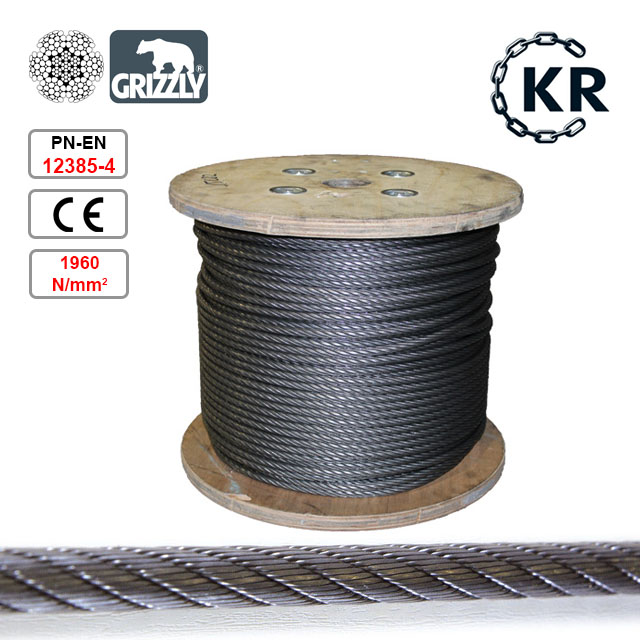
Non-galvanized rope, 6x25 Filler + IWRC, 1960 N/mm2 according to EN 12385-4 (compacted)
High-strength rope (lubricated with a steel core), Country of production - AUSTRIA!
-
Technical data:
- Diameter: 6-16 mm
- Length: to choose from (gross price per 1m)
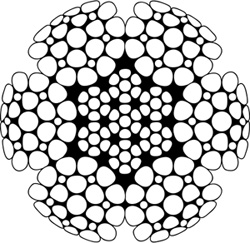
- Construction: 6x25 Filler (6mm - 6x19 Seale)
- Core: IWRC - steel
- Coil direction: sZ - right anticoil
- Standard: EN 12385-4
- Strength: selectable (3.5 t - 23.0 t)
- Strength class: 1960 N/mm2
- Surface: blank - non-galvanized, lubricated
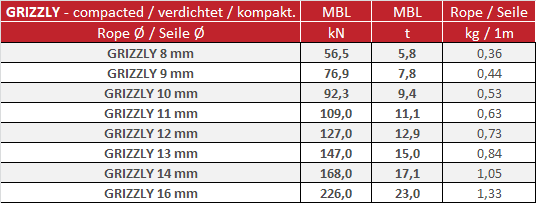
- Weight: given in the table below
Item description:
- Compacted rope (pressed, hammered, swaged, ...), pressed in a press under great pressure.
- Rope designed for forestry - for tree removal, for forestry winches.
- A rope ideal for work in difficult conditions - a rope with very high friction resistance.
- Reducing the rope diameter while maintaining the same strength allows a longer rope to be wound onto the winch drum.
- Improving rope parameters in the compaction process significantly increases the rope's service life and thus reduces its operating costs.
- The steel core and more rounded shape protect the rope from splitting if it is not wound properly on the winch drum.
- Compressing the rope makes it harder for contaminants to get inside the rope.
- Anti-coil rope - does not require the use of a swivel.
Technical parameters
(weight = rope weight x length):
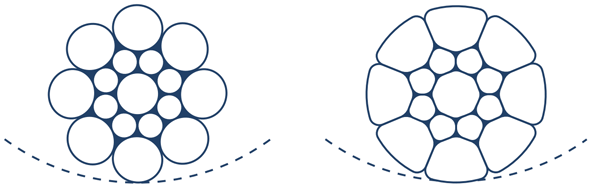
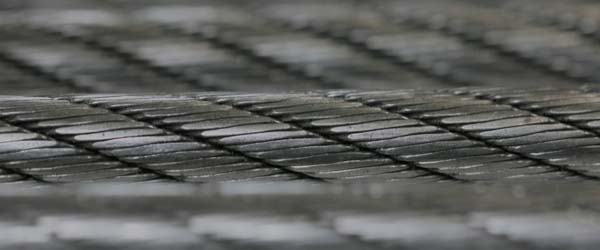
Compacted ropes are ropes that have been additionally subjected to a compaction (crushing) process. The rope before compaction is shown on the left, and the rope after compaction is shown on the right. During the compaction process, the wires and strands undergo plastic deformation, the rope's diameter decreases (while simultaneously increasing its metallic cross-section), and its outer surface becomes smoother. This increases the contact area between the rope and the surface it slides over. This increases the rope's resistance to friction, as the friction force is distributed over a larger surface area.
Opinions
If you've added a review and it doesn't appear on the list, it may be pending moderation.
Leave feedback on the product
